Stringball Golf Game: Rules
Stringball — “La Ficelle” in France — is your handicap made visible and playful. Every player starts with a string: a bank of centimetres in proportion to their handicap, worked out like this: playing handicap × length per point (the convention in France is 50 cm per point; the organiser is free to set this length). At any point in the round, you can move your ball by the length you use up: getting out of a bunker, wiping out a bad lie, bringing a putt closer… until the bank runs out — once the string is gone, no more jokers. You count your strokes as in classic stroke play, and the fewest strokes wins. No net score to work out at the end of the round: the string replaces the strokes received, and the balance is already struck, since the higher the handicap, the longer the string. Instead of abstract strokes received, a real bank to spend — and every use is a delicious dilemma: now, or save it for something worse? 2 to 4 players, each with their own ball.
▶ The rule in 60 seconds, in French with English subtitles — the Game of Swing channel
How to play Stringball
- Work out each player's string: playing handicap × length per point. The convention in France is 50 cm per point (in English-speaking countries, often 1 foot ≈ 30 cm). A handicap of 18 gets 900 cm; a scratch player, no string at all.
- Play and count your strokes, as in classic stroke play — the string takes the place of the handicap, there is no net score.
- Move your ball whenever you like, by a length of string: out of a bunker, a better lie, a shorter putt…
- Every move is deducted from the bank. String used up = no more moves possible.
- Final score in stroke play: the fewest strokes wins.
Length: 50 cm per handicap point. Élodie (handicap 18) starts with 900 cm of string, Théo (10) with 500 cm, Samir (8) with 400 cm. On hole 6, Élodie's ball is plugged in the bunker: she “pays” 80 cm to place it on the grass and saves her par. On the 18th, she has 40 cm left — spent on one last clean lie. End of the round: Élodie wins with 85 strokes, ahead of Samir (87) and Théo (90).
| Player | Handicap Index | Starting string | Final score |
|---|---|---|---|
| 🥇 Élodie | 18 | 900 cm | 85 strokes |
| 🥈 Samir | 8 | 400 cm | 87 strokes |
| 🥉 Théo | 10 | 500 cm | 90 strokes |
Your handicap made visible — and self-balancing
That is the whole elegance of the format: instead of the abstract strokes received on a net scorecard, every player can see their advantage — a bank of centimetres that melts away hole after hole. And the balancing takes care of itself: the higher the Handicap Index, the longer the string, and the levels draw closer together naturally, with no net-score calculation at the end of the round. The beginner can play to win against the low handicapper, and everyone lives through their own management dilemmas.
The right strategy: spend at the right moment
Don't burn through your string at the first obstacle: a 50 cm move that saves a whole stroke (unplayable bunker lie, a tree root) is worth more than a metre of comfort. Always keep something in reserve for the last few holes — that is often where the round is decided, and a player who has run out of string has no joker left.
Frequently asked questions
How is the length of each player's string worked out?
String = playing handicap × length per point; the convention in France is 50 cm per point (the organiser can set a different length). A handicap of 18 therefore gets 900 cm of string. The higher your handicap, the bigger your bank of centimetres — it is your handicap made visible, and it replaces the strokes received.
When can you use your string?
At any point in the round: getting out of a bunker, wiping out a bad lie, bringing a putt closer… You move your ball by whatever length you like, and each move is deducted from your bank of centimetres.
What happens when the string runs out?
No more moves are possible: you finish the round without a joker, playing your ball as it lies. Hence the value of keeping something in reserve for the last few holes.
How do you win at Stringball?
On total strokes, as in classic stroke play: the player with the fewest strokes wins. There is no net score to work out at the end of the round — the balance between the different levels has already been struck by the length of string each player was given.
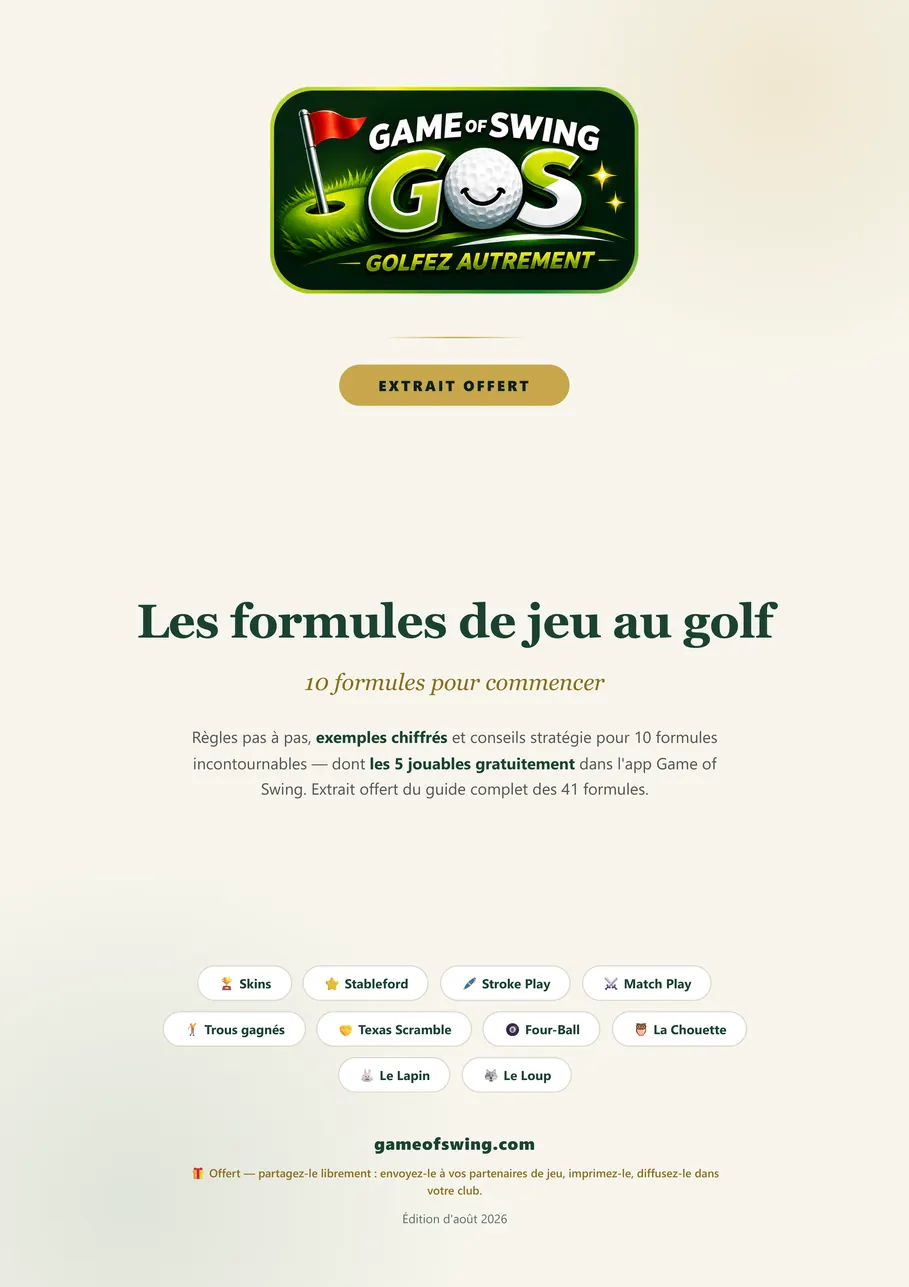
Every format on a single page: step-by-step rules, a worked example, the points scale and a strategy tip — to read the night before a round or to print. The free sample covers 10 formats, including the 5 you can play for free in the app; Stringball is in the complete guide.
Download the free sample →PDF · 14 pages · direct download, no email needed · the complete guide covers all 41 formats
Your next round is a Stringball round
The Game of Swing app works out each player's string, deducts every centimetre used and shows the string remaining live, alongside the stroke play leaderboard. Stringball is waiting in the catalogue of 41 formats — with 5 free games to get you started.
Try the app for free → 5 free games, no account required — on your phone and computerGot a game in mind? A house variant to share? The app grows with every update — send us your idea, the best ones join the catalogue.